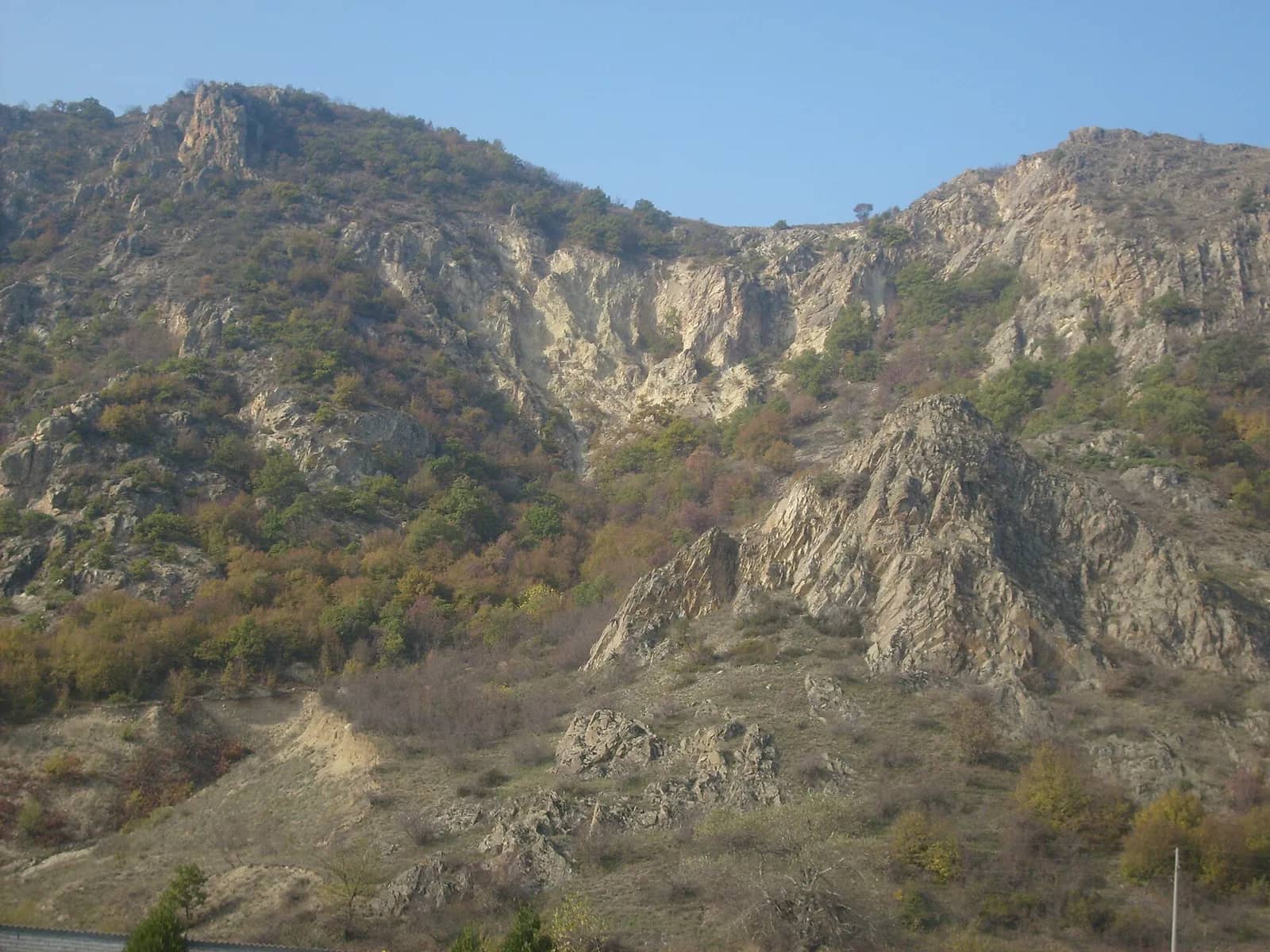
Photograph: In-cognito (Bulgarian Wikipedia) · CC BY-SA 3.0
Rupite is a small village on the flank of an extinct volcano, with a spring at 71°C to 78°C. It is known around the world as the place where Baba Vanga lived, and thousands of people come for her sake. You can come for the quiet as well.
( at a glance )
Rupite, in a few lines
01
Kozhuh, the remains of a volcano, rises 281 metres out of the flat Petrich plain
02
Springs at 71°C to 78°C, about 35 litres a second
03
The ruins of an ancient town, Heraclea Sintica, from the 4th century BC to the 6th century AD, lie at the foot of the hill
04
A protected natural landmark since 1962
05
201 species of birds have been recorded, on one of Bulgaria’s two main migration routes
06
The church of St Petka of Bulgaria was built with Vanga’s support
( the place )
About Rupite
Vangelia Gushterova, known as Baba Vanga (1911 to 1996), lived her last years in a small house at Rupite. According to her relatives she thought of the place as an energy source, and it still draws visitors from many countries. Her predictions are a matter of belief, and HAWA does not vouch for them. What is plain is that this is a place of pilgrimage for many people, and a quiet one.
Beyond the church there is the hill itself, volcanic rock and white poplars, with almost every kind of snake found in Bulgaria and four species of tortoise, and the warm spring that comes up out of the ground. The ruins at the foot of Kozhuh are of a Thracian town, and a Latin inscription found in 2002 suggests it was Heraclea Sintica.
go for
A quiet half-day from Sandanski or Melnik
The church, the hill and a very hot spring in one stop
Birdwatching on the Struma, especially in migration
Yes, as a small, quiet protected area with a volcanic hill, a hot spring and good birdwatching. The pilgrimage side is there if you want it, and easy to leave alone.
Can I bathe in the spring?
Access changes, so check on arrival. The spring is hot, between 71°C and 78°C, and not for bathing in as it comes out of the ground.
How long should I stay?
Half a day is enough. Most people combine it with Sandanski, Melnik or Pirin.
Photographs are openly licensed from Wikimedia Commons and credited under each one.
( need a hand? )
Not sure where to begin in Bulgaria?
Take the four-minute reflection, or ask a real person to help you choose.